
How Does a Standby Generator Work?
The automatic sequence a standby system runs — from outage detection to returning to utility power.
Quick answer
A standby generator monitors utility power through its control and transfer system. When utility power fails, the generator starts automatically and the transfer equipment allows selected electrical loads to receive backup power. When utility power returns, the system transfers the property back to utility power and the generator shuts down after a brief cool-down. The whole cycle happens without anyone starting the unit or flipping a switch.
A standby generator watches the grid, starts itself during an outage, transfers the home safely, then hands power back to the utility automatically.
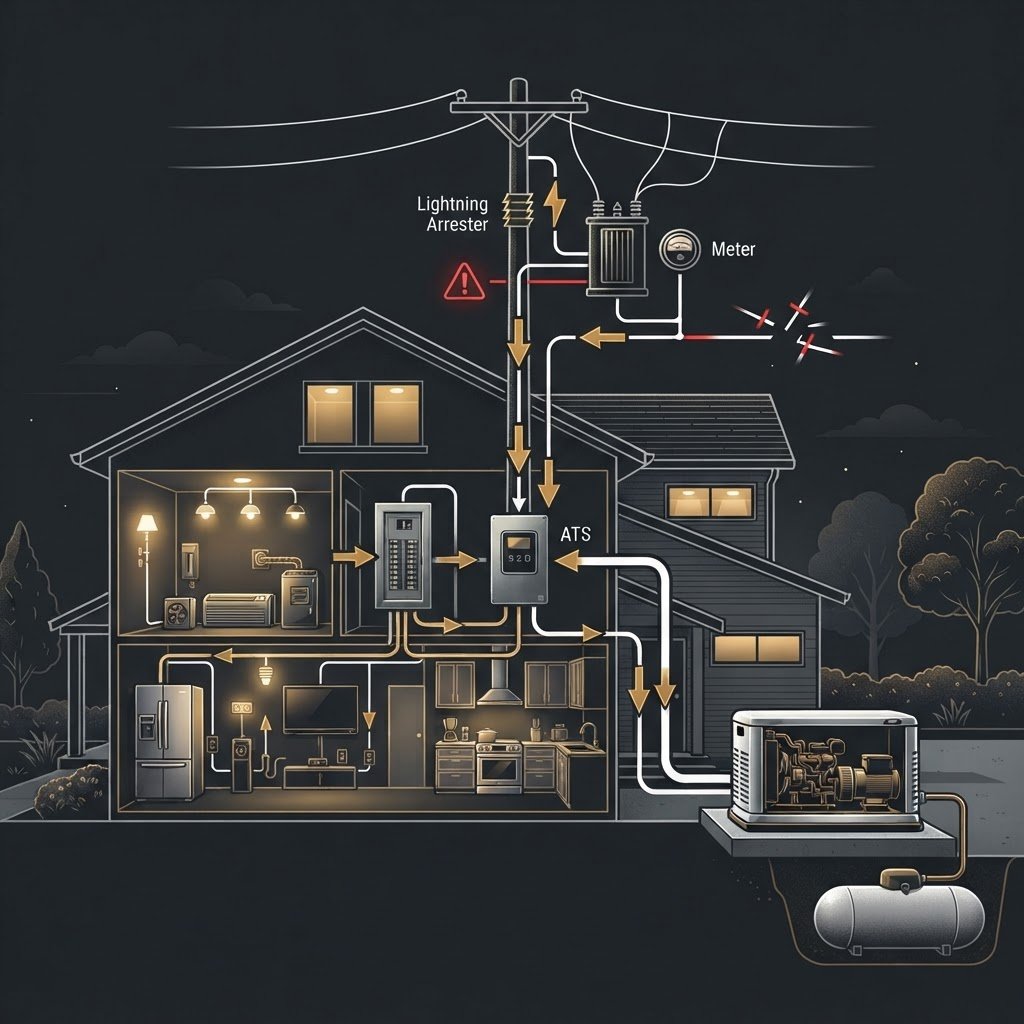
A standby system has three main parts working together: the generator installed outside the home, the automatic transfer switch that decides where power comes from, and the electrical panel that distributes it to your circuits.
How Power Flows Through a Standby System
Every standby installation ties four parts together so the transition between grid and generator power happens safely and automatically.
Utility Power
Grid power feeds the property day to day.
Standby Generator
Detects the outage and starts automatically.
Transfer Switch
Safely switches the home to generator power.
Your Circuits
Selected or whole-home loads stay powered.
During normal conditions, the utility feeds the home through the transfer equipment, and the generator simply waits and monitors. When the grid drops, the path changes.
| Normal | Outage | |
|---|---|---|
| Power source | Utility grid | Standby generator |
| Generator | Idle, monitoring | Running and supplying power |
| Transfer switch | Connected to utility | Connected to generator |
| Your action | None | None — it's automatic |
Power source
Normal
Utility grid
Outage
Standby generator
Generator
Normal
Idle, monitoring
Outage
Running and supplying power
Transfer switch
Normal
Connected to utility
Outage
Connected to generator
Your action
Normal
None
Outage
None — it's automatic
- 1
Outage detected
The control system senses that utility power has dropped.
- 2
Generator starts
After a brief confirmation delay, the engine starts automatically.
- 3
Power stabilizes
The generator comes up to a stable output.
- 4
Transfer occurs
The transfer switch safely moves the home from utility to generator power.
- 5
Home receives backup power
Your selected loads are now running on the generator.
- 6
Utility returns
The control system detects stable utility power again.
- 7
Transfer back
The switch returns the home to utility power.
- 8
Cool-down & standby
The generator runs briefly to cool down, shuts off and returns to monitoring.
The transfer switch is what makes automatic backup power safe. It ensures the home is connected to only one source at a time and never feeds generator power back onto the utility line — which would be dangerous for utility crews and equipment. It's the safety heart of the system, not an optional accessory.
SafetyThis is a concept, not a DIY guide
Connecting a generator to a home's electrical system is skilled, code-regulated work. Never attempt to wire a generator into a panel or backfeed a building through an outlet — it's a serious safety hazard. Transfer equipment exists precisely to do this safely.
Get a project-specific power assessment
Every property is different. Get guidance specific to yours.
Frequently asked questions
Frequently Asked Questions
Straight answers to what homeowners and businesses ask us most.
No. A standby generator starts automatically when it detects a utility outage and shuts down on its own when power returns. That automatic operation is the main difference between a standby system and a portable generator.
There's a short delay while the system confirms the outage is real, then the generator starts and transfers power — typically within seconds to a short interval, depending on the system. It's designed to be brief, not instant, to avoid reacting to momentary flickers.
It coordinates the transition between utility and generator power, ensures the home draws from only one source at a time, and prevents generator power from feeding back onto the utility line. That's what makes automatic backup safe.
Only briefly. Once stable utility power returns, the system transfers the home back to the grid and the generator runs a short cool-down before shutting off and returning to standby.
Related services
- Home Standby GeneratorsPermanently installed backup power that starts automatically when the grid goes down.
- Automatic Transfer SwitchesThe device that safely moves your home between utility and generator power.
- Generator InstallationSizing, placement, electrical integration and transfer equipment installed as a complete system.
- Generac GeneratorsAutomatic standby generator systems for residential and light commercial backup power.
Sun or storms, we have you covered
Get a free, no-pressure power assessment tailored to your property and priorities.