What Size Standby Generator Does My Home Need?
Why generator sizing depends on the loads you want to run, not your home's square footage.
Quick answer
The right standby generator size depends on the electrical equipment you want available during an outage and how much of that equipment may run at the same time. Home square footage alone is not enough to determine capacity accurately. A larger home with modest electrical demand can need less capacity than a smaller home with a well pump, electric range and central air. The most reliable way to size a system is a load-based evaluation of your specific property.
Generator capacity should be based on electrical demand, not simply home size.
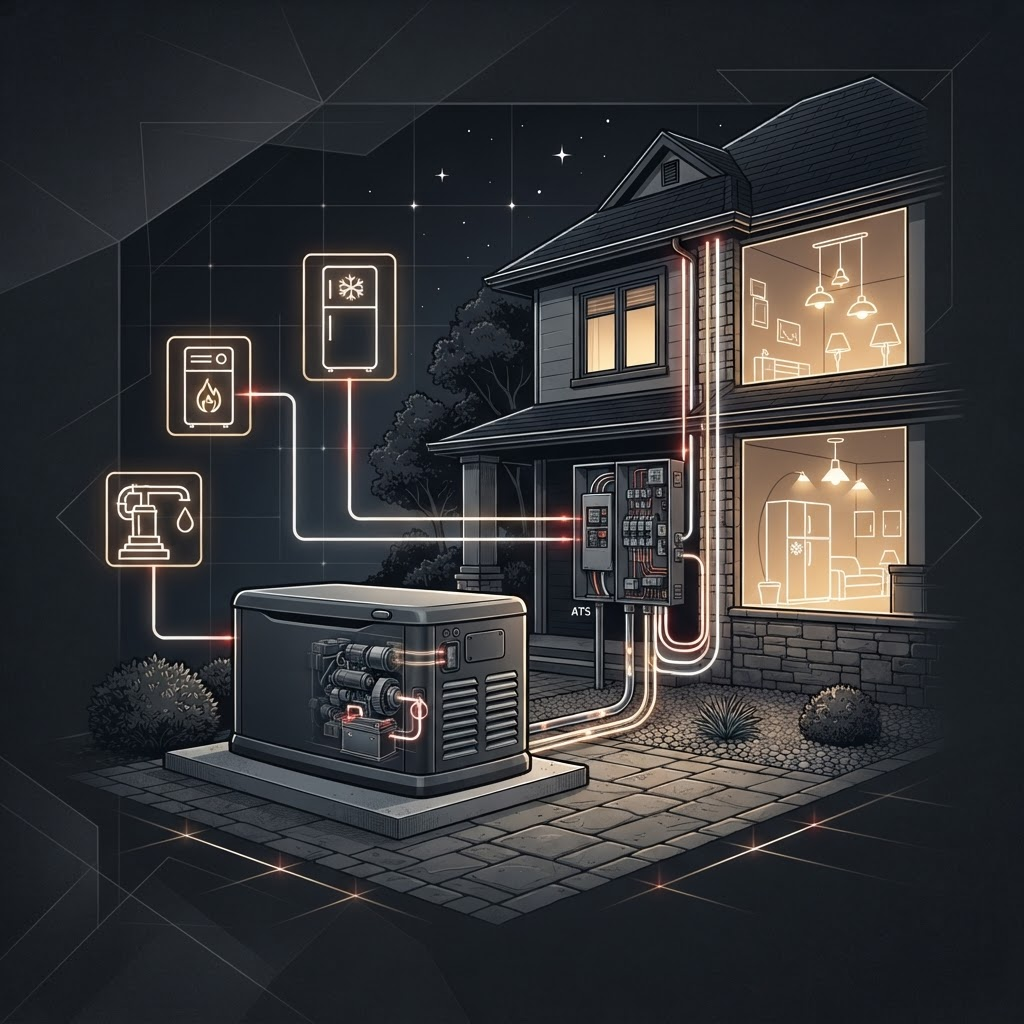
Generator size refers to how much electrical power a unit can supply at once, rated in kilowatts (kW). A standby generator has a maximum output, and the loads you connect to it draw against that capacity in real time. Sizing is the work of matching that output to what you actually want running during an outage.
- Watt (W)
- A unit of electrical power. Small devices are measured in watts.
- Kilowatt (kW)
- 1,000 watts. Standby generators are rated in kilowatts — a 22 kW unit can supply up to 22,000 watts.
Every device has a running load — the steady power it draws while operating. But motors draw a much larger surge the instant they start. That starting load can be several times the running load and only lasts a moment, yet the generator has to be able to supply it.
From the field
A well pump or air conditioner can draw a brief starting surge several times its running draw. Sizing around running load alone is one of the most common ways a system ends up undersized for the equipment it's supposed to protect.
The key sizing question isn't how much everything in your home draws — it's how much runs at the same time. A furnace, well pump, refrigerator and some lights running together set a very different requirement than a whole house running at full capacity.
This is why two homes of identical size can need very different generators. The loads, and how they overlap, decide the answer.
- Essential-load backup: heat, water, refrigeration and key circuits. A focused, smaller system.
- Expanded backup: the essentials plus added comfort and convenience circuits.
- Whole-home backup: the system carries most or all of the home's load, often using load management to handle large appliances.
None of these is automatically 'better.' The right level depends on what you want available and how you want the system to behave during a long outage.
Certain equipment has an outsized effect on sizing because of high running or starting demand:
- Well pumps — high starting surge; the source of all household water.
- Furnaces and heat controls — critical in a Northern Wisconsin winter.
- Central air conditioning — significant starting load in summer.
- Electric range and oven — large loads when electric rather than gas.
- Electric dryer and electric water heater — heavy continuous draws.
- Shop equipment and outbuildings — motors and tools add up quickly.
- EV charging — a substantial, sometimes continuous, added load.
Key takeaway
A home's square footage tells us little about whether a generator needs to start a well pump, air conditioner, electric water heater and shop equipment at the same time.
Online charts that map square footage to a generator size assume an 'average' home. Real homes aren't average. Fuel type, whether heat is gas or electric, the presence of a well, air conditioning and shop loads all move the requirement up or down. A chart can produce a number that's confidently wrong for your property.
A practical first step is deciding what you actually want running. The tool below isn't a kilowatt calculator or a quote — it helps you build the load priority list that a proper assessment starts from.
Build Your Backup Priority List
Sizing a generator starts with knowing what you want to keep running. Select the loads that matter to your household — this isn't a quote or a kilowatt calculation, it's the starting point we use to size a system correctly during your assessment.
Heat & Water
Kitchen & Food
Comfort & Daily Life
Property & Extras
0 loads selected
Select the loads you'd want running during an outage to build your priority list.
A load-based assessment looks at your actual equipment, how it operates together, and how you want the system to behave during an outage. That's the difference between a generator that comfortably carries what matters and one that struggles — or one you paid for capacity you'll never use.
Need a real load assessment?
Every property is different. Get guidance specific to yours.
Frequently asked questions
Frequently Asked Questions
Straight answers to what homeowners and businesses ask us most.
Square footage is a rough starting point at best. Two homes of the same size can need very different generators depending on whether they have a well pump, electric heat, central air or a workshop. Accurate sizing is based on your actual electrical loads and how they run together.
It depends on what you want available during an outage. Essential-load backup covers heat, water, refrigeration and key circuits with a smaller system. Whole-home backup carries most or all of the house. Neither is universally better — the right choice follows your priorities and budget.
Well pumps draw a large surge of current the moment the motor starts, often several times their running draw. Because the pump supplies all household water, it usually needs to be included in the design, and its starting load has to be accounted for so it runs reliably.
Often yes, but central air has a significant starting load, so it has to be planned for. Whether it runs alongside everything else, or is managed so large loads take turns, is part of designing the system around your simultaneous demand.
Related services
- Generator SizingHow standby generators are sized around real electrical loads — not square footage.
- Home Standby GeneratorsPermanently installed backup power that starts automatically when the grid goes down.
- Whole-Home GeneratorsSystems designed to carry most or all of a home's electrical load during an outage.
- Generator InstallationSizing, placement, electrical integration and transfer equipment installed as a complete system.
Serving these communities
Sun or storms, we have you covered
Get a free, no-pressure power assessment tailored to your property and priorities.